Friday, December 4, 2015

Ocelot 

Ocelot 
(Leopardus pardalis)

https://revolutionaryecology.files.wordpress.com
By: Katryna Fogel


What is an Ocelot?


The ocelot (Leopardus pardalis) is a “medium-sized spotted cat” (USFWS) weighing 15-35 pounds as an adult, and can get up to about 4 feet long. The body is gray and cinnamon colored with spots on the head, black stripes on the cheeks, and 5 longitudinal black stripes on the neck. The body is spotted with black ears and a white underpart. The tail is dark with ring and bar-like markings. The ocelot is divided into 11 subspecies, two of which reside in the United States. These are the Texas/Tamaulipas ocelot and the Arizona/Sonora ocelot. 


http://www.tpwmagazine.com


What is their habitat like?

Ocelots are linked to densely covered habitats and ample amounts of vegetation. “Lack of suitable habitat has been cited as an important reason for the endangered status of the ocelot in the US” (USFWS). In Texas, ocelots reside mostly in “dense thornscrub communities,” (USFWS) most of which has been altered for urban development. One study showed that less than one percent of Texas supports the dense thornscrub necessary for the ocelots survival.

http://wildsonora.com


A study done in Peru found that ocelots generally avoid open habitats during the day, but will forage in them at night.  Texan ocelots prefer “shrub communities with more than 95 percent canopy cover and avoid areas with intermediate (50-75%) to no canopy cover” (USFWS).

https://www.desertmuseum.org

Where do Ocelots live?

According to the ocelot’s recovery plan, before the increased destruction of its habitat in the mid-1800s, their homes ranged from Arkansas through Texas and down to the Rio Grande. Now the ocelot lives in the western hemisphere, “where it is distributed from southern Texas and southern Arizona through Central and South America into northern Argentina and Uruguay" (USFWS). Its range includes 22 countries, which proves problematic when it comes to recovery planning. This is due to the fact that USFWS does not have technical jurisdiction over countries outside of the US. 

There are an estimated 800,000 to 1.5 million ocelots in existence worldwide, according to Defenders of Wildlife. In Texas alone there are two isolated populations with approximately 80 to 120 ocelots (defenders.org).
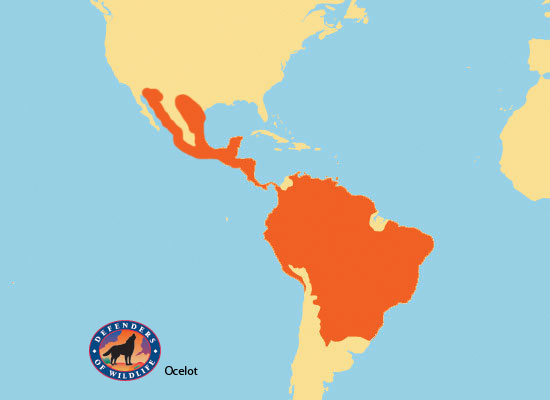
https://www.defenders.org

Listing Status:


Listing: Endangered 
Date: 1982

More specifically, the Ocelot “has a recovery priority number of 5C, meaning that it has a low potential for recovery with a relatively high degree of conflict with development projects” (USFWS).

Main threats to the Ocelots and the reasons for their listing:


The original threat to the ocelot species began around the 1960s and peaked during the 1970s through the 1980s when they were hunted for the fur trade. As many as 200,000 were poached per year for their beautiful fur. Their slaughter was greatly reduced after strict regulations were set. That being said, there are still many that are illegally taken from their habitats. Overall their populations have suffered greatly.
https://encrypted-tbn1.gstatic.com
Additionally, as human populations grow and move into ocelot territory, their numbers are shrinking as their land is being developed for humans. This continued loss of habitat and isolation between the ocelot populations is causing low genetic diversity among the species and keeping their populations low. Habitat destruction has mostly replaced hunting as its major threat and is also now the ultimate cause and reason for the ocelot’s current listing.

Recovery strategy for the ocelot. What is it?

The current recovery strategy for the ocelot involves “the assessment, protection, reconnection, and restoration of sufficient habitat to support viable populations of the ocelot in the borderlands of the US and Mexico,” (USFWS) reducing the human population’s impact on ocelot survival, improving genetic fitness and health of the ocelot, as well as the development of incentives for landowners to abide by current regulations regarding the management and monitoring of ocelot populations. By attempting to better understand the status and conservation needs of the ocelot, we can further prevent the decline of their populations. The recovery plan also includes providing a migratory corridor between the Texas populations and the Mexico populations in order to increase the overall ocelot populations and create a wider gene pool for the species. The ultimate recovery goal for the ocelot is to restore and recover both the ocelot and its habitat for long-term results in order to ensure its sustainability and remove it from the endangered species list. 
https://encrypted-tbn2.gstatic.com

A five step summary of the Recovery Plan:


1. First is to create an all-inclusive model for conservation of the ocelots in the regions bordering the US and Mexico in regards to their habitats and population connectivity. 

2. Reduce the effect of the population growth and development on the ocelots, and ultimately reduce the road casualties for ocelots. 

3. Maintain and overall improve the health, gene pools and genetic diversity amongst the ocelot populations. 

4. Involve the surrounding communities in commitments, regulations, education and awareness in order to help protect the ocelots. 

5. Continue efforts to gain information and maintain populations regarding ocelots further outside the USFWS jurisdiction. 

What can you do to help?
https://encrypted-tbn2.gstatic.com

The best way to help save the ocelots is by donating. The Environmental Defense Fund has a plan to save the ocelots by “strengthening the genetic pool of the remaining ocelots and protecting and increasing the size of ocelot habitats” (EDF). You can donate to their cause here.

https://encrypted-tbn2.gstatic.com
If you are interested in “adopting” an ocelot, you can donate below through World Wildlife Fund and help fund research that will aid in saving the world’s ocelot population. Click here!


Sources: 

"3.27.15." Issuu. N.p., n.d. Web. 05 Dec. 2015.
"Basic Facts About Ocelots." Defenders of Wildlife. N.p., 11 Apr. 2012. Web. 05 Dec. 2015.
"Ocelot - International Society for Endangered Cats (ISEC) Canada." International Society for Endangered Cats (ISEC) Canada. N.p., n.d. Web. 05 Dec. 2015.
The Ocelot. Clarksville, AR: Journalism Class, Clarksville High School, 1936. Web.
"Recovery Plans Search." Endangered Species. N.p., n.d. Web. 05 Dec. 2015.
"World's Car Population Hits 1 Billion." The Huffington Post. N.p., n.d. Web. 03 Dec. 2015.


Laysan Duck

LAYSAN DUCK
Anus Laysanensis

WHAT ARE LAYSAN DUCKS?
            The Laysan teal is a small duck that inhabits an island in the Hawaiian Islands. It grows to roughly 14 oz. as an adult. They are mostly light brown with white-eye rings and a purple green wing patch. The males have darker feathers around their head, and sometimes their heads take on a greenish tint. Males also have a blue-green bill with black spots along the top.  
            They spend the majority of their time in vegetation and come out at night to feed. When studying the movement habits of the birds it is found that they spend over 50% of their time in the interior, terrestrial, part of the island. With most of the remaining time spent in or near the lake. The Laysan ducks eating habits are still debated over, but there are strong studies that conclude their diet contains mainly insects such as beetles and ants. It has also been recorded that they increase consumption of brine flies in certain months.


Satellite photo of Laysan Island
       www.pbs.org   
WHERE DO LAYSAN DUCKS LIVE?
www.honolulumagazine.com
            The ducks are found specifically on Laysan Island and the Midway Atoll in the string of Hawaiian Islands. Just recently the duck was also translocate to Kure Atoll at the top of the archipelago. It was thought that they were 
endemic to Laysan Island, until biologists found bones on many other islands. It is now believed that the Laysan duck once inhabited the whole of the archipelago.
            Populations of the Laysan duck are hard to estimate because they hide in vegetation most of the day. In the early 1900’s it was estimated that there were only seven birds, and by 1961 the estimate grew to 688. Although the population declined around 1993 there has been a strong rebound and there are currently 300-600 birds on the island. Since the carrying capacity of the island is not very large and the resource availability is low, the populations should not increase much more.

WHEN AND WHY ARE THEY ON THE ENDANGERED SPECIES LIST?
            Listed: Endangered. March 11, 1967. 
first of us torpedo boats uss cushing
http://www.building-model-boats.com/torpedo-boats.html
           
            The main decline of the Laysan ducks is still unknown but it is thought that colonizers brought invasive predators such as the rat and mouse. This limited the ducks to only Laysan Island. In the late 1800’s their populations sustained another blow when invasive rabbits took over the island, which led to a great loss of vegetation. The loss of vegetation brought the population down to seven ducks in 1912. Since then they have suffered declines from avail flu but recovered well.
            The main threats to the Laysan duck today are its low population size and its range of only two islands. This leaves the ducks open to extinction from natural disasters or another introduction of an invasive predator. With a very short range the ducks survival is based off limited resources. If these resources are altered in any way it can cause the birds to drop in numbers.

WHAT IS BEING DONE TO HELP?
Laysan Duck and ducklings
https://www.fws.gov/pacific/ecoservices/documents/LaysanDuckRRP/LaysanDuckRRP.html
            The long-term recovery goals are to conserve and recover the Laysan so that it can be downgraded to a threatened species and eventually be taken off the List of Endangered and Threatened Wildlife and Plants.
            To accomplish this goal the ducks on Laysan Island are being monitored to keep them protected. The U.S. Fish and Wildlife Service plans to establish additional populations on other areas that are virtually predator free. There are four main steps to the recovery plan to ensure that the ducks increase their populations.
1.     The habitat on Laysan needs to be restored and protected.
2.     Young ducks need to be transferred to viable non-predatory islands in the Hawaiian Islands.
3.    Captive breeding and the translocation of these ducks to the predator controlled Main Hawaiian Island sites needs to be implemented.
4.    Further research on the life history, genealogy, and other areas to further enhance the recovery of the Laysan duck.

WHAT CAN YOU DO?
            You can help by donating money to the Hawaii Wildlife Center at:

            You can also donate to Birdlife International at: http://www.birdlife.org/worldwide/programmes/preventing-extinctions
Hawaii Wildlife Center
http://www.gokohala.com/activities.html
They fund conservation actions on an array of endangered birds.

You can also help through education of others. The more people that know the plight of the Laysan duck the more people that can help.


Sources:

“Endangered Species in the Pacific Islands”

“Laysan Duck”

Anus Laysanensis

Laysan duck species fact sheet.

“Return of the Laysan Ducks”
http://www.hawaiiwildlifecenter.org/

Flying Away from Extinction


The El Segundo Blue Butterfly

By: Leah Gilchrist


Ecology and Life History
The adult butterflies are about .8-1 inch in size. The males are a bright blue color, while the females wings are brown. However, both males and females have an orange border on their upper wings lined by dots. Before they reach their full grown adulthood that only lasts between 2-7 days, the butterflies must undergo their early stages of life as larvae. The butterflies start out as eggs that usually hatch between 3-5 days. These now larva undergo 4 instars before they pupate, which takes 18-25 days. The larva form a symbiotic relationship with ants; the ants are attracted to a sweet secretion the larva release, and in return protect them from predators and parasites. During this month as larvae, they must feed on the flowerheads and seeds to complete their development. The next stage of metamorphosis is the pupa stage, which is about 90% of their entire life. They burrow themselves underground until they are ready to emerge as butterflies. They spend their time as a butterfly near the coastal buckwheat, their main form a food. They have only 2-7 days to suck nectar, perch, mate, and then for the females lay eggs. The reason their lifespan is so short is due to crab and lynx spiders that prey on them. 
This image above displays the difference between the larva in its last instal and the pupa. Although both are similar in size (about 5 millimeters) the pupa is similar to a chrysalis, and the larva is in its caterpillar form. 


Changes in Geography and Population
The blue segundo butterfly occurs mainly in the El Segundo Sand Dunes. This is due to their food source, the coastal buckwheat, flourishing in these dunes. However, there are four other main populations located in Ballona Wetlands, Airport Dunes, Chevron butterfly preserve, and Malaga cove. The population began to decline in 1938, but we have seen the most dramatic declines in the 25 years prior to its listing in 1976. “This has been as a result of the re-alignment of the Pershing Drive, construction of Imperial Highway, moving sand to build the VOR hill, and fragmentation and scraping of the coastal prairie. The habitat degradation resulted in extirpation of many native species and the invasion of the site by exotic plants and animals.” (FWS Recovery Plan) Alien plant species were introduced to the Sand dunes population, and caused major problems between native species. There is the issue of competitoin, and native species going extinct. 

Listing Information and Threats
In 1976, when less than 500 of the butterflies were counted, the species became the first insect listed as a Federal Endangered Species. It was officially listed on June 1st, 1976. While it was at a high risk of extinction, scientists thought it had a great chance of recovery, leaving it at a recovery priority of 3.The goal of recovering the species was to get it down listed from endangered to threatened. The major threats on the species are invasive species, off roading vehicles, and human foot traffic that has been trespassing. However, the biggest change to the environment was the purchase and clearing of residences from nearly 200 acres. This affected all of the native species to the Airport Dunes. There are now security gates up designed to keep out the public of the El Segundo Dunes.

Recovery
The official recovery plan was devised in 1998 by the U.S. Fish and Wildlife Services. Since the implementation of this plan, the butterfly populations have already begun to increase. In 1986, the Los Angeles Worldwide Airport, began the LAX Dunes Restoration Project in hopes of restoring the butterflies, as well as some of the other native species in danger of extinction. In their plan to bring back the butterflies, they intended to focus on protecting the coastal buckwheat since it is their main food source. The FWS recovery plan stated that the species would be down listed when the four butterfly recovery units maintained stable populations, and the public was informed about the species and their habitat. The total estimated cost of recovery was $4,436,00. Removal of the exotic plants and animals was necessary in order for the native species to thrive on there own again.In addition to removing specific species, scientists planned to do captive breeding for the butterflies, in order to help preserve the el segundo butterflies while their habitat was being restored. Many of these efforts are listed as ongoing, but we have already seen a significant improvement in the butterfly population.


This graph displays how the recovery plan has helped the butterfly species grow and increase greatly since the plan has been in action. 

TO READ MORE ABOUT THE EL SEGUNDO BLUE BUTTERFLY RESTORATION AREA FOLLOW THIS LINK http://www.atlasobscura.com/articles/el-segundo-butterfly-preserve

Works Cited

  •      "El Segundo Blue Butterfly." Los Angeles Times. Los Angeles Times, n.d. Web.
  •       LAX Dunes Preserve (n.d.): n. pag. LAWA. Web. .
  •      Recovery Plan for the El Segundo Blue Butterfly (n.d.): n. pag. U.S. Fish and Wildlife Services. Web.
Pictures
http://www.esasuccess.org/images/graphs/1324.png
http://environment101eng.weebly.com/uploads/2/5/0/5/25054349/1608490_orig.jpg 
http://www.latimes.com/local/la-me-blue-butterfly30-2009jul30-pictures-photogallery.html

Thursday, December 3, 2015

The Snow Leopard

The Snow Leopard(Panthera uncia

The Ghost Cat

                                                                                      by Jefferson Escamilla
Photograph by Dr. George B. Schaller


What is The Ghost Cat?
“The Ghost Cat” aka the snow leopard,  belongs to the panthera genus, and is referred to as “The Ghost Cat” because the snow leopard can disappear from sight very quickly and is quite rare to see.  This grey feline is has thick fur with dark spots that are unique to each snow leopard.  This specie has tremendous strength in it’s legs that let the snow leopard jump about 50ft.  They also range from 4ft to 5 ft with their tail adding another 3ft.  Weighing between 60 and 120lbs, the snow leopard is capable of killing species three times. 
The Range of the Snow Leopard


Here is a video of two snow leopards, a mother and her cub. 

Where do they live and what do they eat?
The snow leopard lives in the harsh conditions of the Himalayas which is why it has a thick coat of fur and tough paws.  The snow leopard is the apex predator and preys on blue sheep, ibex, game birds and small mammals. It also occasionally preys on domesticated animals as well.

Photograph by Steve Winter
Quick Facts:
  • Snow Leopards can’t roar
  • Ready to mate between 3-4 years old
  • Their tail helps them balance and keeps them warm by wrapping them selves with it
  • Most active at Dusk and Dawn


“Sean O’Connell: They call the snow leopard the ghost cat. Never lets itself be seen.
Walter Mitty: Ghost cat.
Sean O’Connell: Beautiful things don’t ask for attention.”(The Secret Life of Walter Mitty)

Threats 

listed 03/28/1972 
The snow leopard is a very beautiful creature but is an endangered specie. The snow leopard is constantly being threatened.  From farmers retaliating for the killing of their livestock to poachers killing snow leopards for their fur and bones for traditional Chinese medicine, the snow leopard is in jeopardy. Habitat destruction is taking the major toll on the snow leopard population.  Farmers are overgrazing on the lands which decrease the food supply for the snow leopards prey, that ultimately decrease the snow leopards population.

Recovery Plan


The ultimate plan is to have a self sustaining population in the wild. But to do that there are steps that must be taken.  Some countries like Afghanistan are now adopting conservation policies in-order to protect this creature.  The road to recovery must include the following: 
  • Educating the local’s in sustainable farm practices that do not impact wildlife severely. 
  • Create ecotourism that promotes conservation on the local, national and global level for the snow leopard
  • Increase patrol on trade routes to prevent the selling of snow leopard goods
  • Involve the national government to create and enforce laws pertaining to the killing,trade, or possession in order to protect the specie.
What can you do?
You probably can't go to the Himalayas and protect these beauties but you can still help!  Spread the word about the endangerment of the Snow Leopard.  You can also check out http://www.iucnredlist.org/http://www.snowleopard.org/, and http://www.worldwildlife.org/  and make a small donation to help contribute to the protection of the snow leopard.  
Just Remember it's not to late to save The Ghost Cat!

Sources
“Snow Leopard.” WorldWildlife.org. World Wildlife Fund, n.d. Web.
http://wwf.panda.org/what_we_do/endangered_species/snow_leopard/

Wallpaper -- National Geographic for Milestones in Wildlife Photography. 1970s. National Geographic, Pakistan’s, Chitral Valley. National Geographic.  

Winter, Steve. Out of the Shadows. Digital image. Http://ngm.nationalgeographic.com/2008/06/snow-leopards/winter-photography#/10-cat-snow-714.jpg. National Geographic, n.d. Web.

Winter, Steve. Out of the Shadows. Digital image. Http://ngm.nationalgeographic.com/2008/06/snow-leopards/winter-photography#/13-cat-night-714.jpg. National Geographic, n.d. Web. 

Jackson, R., Mallon, D., McCarthy, T., Chundaway, R.A. & Habib, B. 2008. Panthera uncia. The IUCN Red List of Threatened Species 2008: e.T22732A9381126.   http://dx.doi.org/10.2305/IUCN.UK.2008.RLTS.T22732A9381126.en

McPherson, Angie. “Rare Pictures: Snow Leopards Caught in Camera Trap.” National Geographic. National Geographic Society, 25 Jan. 2014. Web. 01 Dec. 2015. .

The Secret Life of Walter Mitty. Dir. Ben Stiller. Screenplay by Steve Conrad. Adapt. James Thurber. Perf. Ben Stiller,Kristen Wiig, Sean Penn. 20th Century Fox, 2013. DVD.

Wednesday, December 2, 2015

Ghosts of the Mountains by Casey Garrett


    Scientifically known as Panthera uncia, Snow leopards are rare, gorgeous gray cats who reside in the cold, treacherous mountains of Central Asia. They are so rare and elusive in fact that they are commonly referred to as "ghosts of the mountains". With bodies beautifully designed to combat the fierce mountain chill, they are insulated by thick smoky, spotted fur and their massive, insulated paws act as natural snowshoes. If spotted, snow leopards are most likely to inhabit high rocky mountainsides, alpine meadows, and high altitude forests.

    Snow leopards are expert mountaineers and ideal for their cold, harsh environment for many reasons. First, they have short front limbs and powerful hind leg muscles that can leap as far as 30 feet in the snow. Built with especially sturdy chest muscles, snow leopards have the ability to maintain stamina when climbing steep mountainsides. They also utilize their long, thick, bushy tails for balance and warmth.


Snow Leopards are opportunistic hunters but they prey mainly on blue sheep and the mountain ibex. One average, snow leopards are 4-5 feet in length and weigh 60-120 pounds. Astoundingly, they can kill prey three times their size!

BEHAVIOR:

    Snow leopards are vey shy creatures who live primarily in solitude. Scientists have found that the best methods for observing this species is through camera traps and natural markings. Dawn and dusk are the best times to spot a snow leopard. Female snow leopards are able to give birth at around 2-4 years in age with gestation periods lasting from 90-110 days. They usually mother 2-3 cubs at a time who remain dependent for 1.5-2 years before becoming independent. Snow leopard’s natural lifespan ranges from 18-20 years.

* GREAT VIDEO CAPTURING THE BEAUTY OF THE SNOW LEOPARD


    Snow Leopards are typically found at altitudes between 9,800 and 17,000 feet in the high, dry, rugged mountains of Central Asia. Snow Leopards are known to have populations in the following countries: Afghanistan, Mongolia, Nepal, Pakistan, areas of Russia, Tajikistan, and Uzbekistan. China contains roughly 60% of snow leopard habitat and scientists estimate that there are only 3,500-4,000 snow leopards remaining in the wild with 700 in captivity.


There are four major threats to the remaining snow leopard population:


1. Poaching
Poaching has always been a problem with snow leopards due to their silky soft thick pelts. Snow leopard's limbs, organs and bones are also treasured in traditional Asian medicine. In addition, many of the geographic areas that snow leopards are found are also abundant with poverty and low-income families. The pelt of a snow leopard is highly valuable and worth large sums of money. For a poor desperate farmer, the skin of a snow leopard could easily propel him or her to wealth. With low levels of economic prosperity in the central Asian region, some hotels go as far as selling snow leopard pelts to tourists.

CLICK TO SEE FASCINATING VIDEO ABOUT SNOW LEOPARD POACHING

2. Conflict with communities
Local farmers and herders kill snow leopards in retaliation to them eating livestock. As a result of habitat loss, climate change, and a decline in the availability of natural prey, hungry leopards are forced to prey on the livestock of farmers.

3. Habitat destruction, degradation and fragmentation
Snow leopards need large amounts of space to be at optimal fitness. Expanding human and livestock populations are rapidly encroaching on the habitats of snow leopards. Although human population density in the snow leopard’s habitat is relatively low, people whose livelihoods depend on their livestock heavily utilize it. Combined with a high demand for goods such as cashmere, herds have increased in size and overgrazing has become a serious issue. New roads and mines are also fragmenting snow leopard habitat.

4. Climate change
Due to the fact that climate change causes temperatures to gradually increase, snow lines recede on the mountain ranges. As snow leopards move to higher elevations in search of prey, the vegetation becomes scarcer, which means that prey becomes limited and the leopards struggle to find sustainability


WHY ARE SNOW LEOPARDS IMPORTANT?

    The snow leopard is a cultural and economic symbol of healthy high-mountain ecosystems.They have a lot of instrumental value and contribute to human wellbeing by providing biodiversity and cultural significance. Snow leopards are an important cultural and spiritual symbol in Central and South Asia. In addition, the species promotes recreation and tourism to aid economic growth.

    Snow leopards were declared endangered by the United States Fish & Wildlife Service in 1972 and was placed on the International Union Conservation of Nature Red List in 1986.The Global Snow Leopard and Ecosystem Protection Program (GSLEP) seeks to conserve snow leopards and their high-mountain ecosystems.

    One of the primary goals of the GLSEP is identify and secure at least 20 healthy populations of wild snow leopards by 2020. In order to do that, there are 7 main commitments that all 12 countries that contain snow leopard populations must take in order to achieve the ultimate goal of ensuring that snow leopards and the people who live among them contribute to the prosperity and well-being of communities and the planet.

The 7 general steps to recovery according to the GLSEP are as follows:

1. Engaging local communities in conservation.
2. Managing habitats and prey of snow leopards via close monitoring. This includes evaluation of    specific range areas of populations.
3. Combating poaching and illegal trade of snow leopards.
4. International management of snow leopards and enforcement of that management through industries.
5. Continued research of snow leopards.
6. Enhancing conservation policies and institutions.
7. SPREADING AWARENESS of the snow leopard.

What Can You Do?

DONATE to the Snow Leopard Trust!

HERE is the link to the website. through the Snow Leopard Trust, you can also symbolically adopt a snow leopard! The money donated through this fund is used to exclusively support projects on Snow Leopard conservation in 5 of the 12 countries where snow leopards are found.


1. Snow leopards are actually not aggressive towards humans. There has never been a documented report of a snow leopard attack. Due to their shy nature, snow leopards are more likely to flee a threatening situation rather than acting in aggression.
2. Snow leopards do not have the ability to roar as a result of the structure of their vocal chords.
3. CUTE SNOW LEOPARD'S BFF VIDEO
4. Scientists still know little information about the snow leopard because they are so elusive.
5. Unlike other big cats, snow leopards have light eyes ranging from pale green to icy blue.


THANKS FOR READING!


WORKS CITED:


1. Global. SNOW LEOPARD ECOSYSTEM (n.d.): n. pag. Global Snow Leopard and Ecosystem Protection Program Conference Document for Endorsement. Web.

2. "Saving Snow Leopards Since 1981." Snow Leopard Trust. N.p., n.d. Web. 04 Dec. 2015.

3. "Species Profile for Snow Leopard (Uncia (=Panthera) Uncia)." Species Profile for Snow Leopard (Uncia (=Panthera) Uncia). U.S Fish & Wildlife Service, n.d. Web. 04 Dec. 2015.

4."Snow Leopard." WorldWildlife.org. World Wildlife Fund, n.d. Web. 04 Dec. 2015.

5. "Basic Facts About Snow Leopards." Defenders of Wildlife. N.p., 08 Apr. 2012. Web. 04 Dec. 2015.


Photos:

1. http://www.webmastergrade.com/wp-content/uploads/2009/11/Snow-Leopard.jpg
2. https://s-media-cache-ak0.pinimg.com/236x/59/07/ab/5907abdd36ef6f1143106184d6f72e10.jpg
3. http://www.celsias.com/media/uploads/admin/Jason_Brown2.jpg
4. http://ihdwallpapers.com/wallpapers/2012/05/24/amazing_snow_leopard-640x960.jpg
5. http://applespecialist.com/images/SnowLeopardTrust.jpg
6. url
7. http://cache1.asset-cache.net/gc/88550365-moon-over-snowy-mountains-gettyimages.jpg?v=1&c=IWSAsset&k=2&d=Vt7t2ZA%2F8dUzyLaJgBMQBdvumzy9DUnXkmQPQuXwipU%3D
8. http://www.snowleopard.org/wp-content/uploads/2013/02/P1120807.jpg
9.http://media2.popsugar-assets.com/files/2010/06/23/5/192/1922243/snow_leopard_08_wenn2881763/i/Pictures-Baby-Snow-Leopards.jpg
10. https://c2.staticflickr.com/8/7029/6608415317_bbb47cf907_b.jpg
11.http://www.snowleopard.org/wp-content/uploads/2012/03/Snow-Leopard-Range-Map-GSLEP.jpg

Northern Sea Otter


The Northern Sea Otter
By Olga Esmeral

What is a Northern Sea Otter?

The Northern sea otter (Enhyra ultras kenyoni) is the largest species in the mustelid family, and is one of the smallest marine mammals. Adults may grow up to 5 feet in length, males weighing  80–100 lbs. and females 50–70 lbs. It has unique adaptations, allowing it to thrive in the nearshore marine environment. As the only marine mammal species that lacks a blubber layer, it is dependent on a dense coat of fur for insulation from cold water. They have a pretty high metabolic rate that helps them maintain body temperature. This requires them to consume large amounts of prey, as much as 20-33% of their body weight each day. This diet mainly consists of benthic invertebrates. Their habitat is generally in or near shallow water. The threatened population includes the Southwest Alaska Distinct Population Segment.

Range


Sea otters do not migrate long distances. They usually stay in a home range that could consists of a few square km up to 40 km2. The northern sea otter subspecies (E. lutris kenyoni), is found in the Aleutian Islands, Southern Alaska, British Columbia, and Washington. There are 3 stocks in Alaska. The Southeast stock is in the coastal waters of Southeast Alaska. The southcentral population goes from west of Glacier Bay to the eastern edge of Cook Inlet. The Southwest population stretches from the western edge of Cook Inlet out the Aleutian islands. 


What Happened to the Cutest Marine Mammal?

The estimated population of sea otters worldwide was once between several hundred thousand to over one million before to almost facing extinction by hunting of fur traders in the 1700s and 1800s. Sea otters eventually gained protection from International Fur Seal Treaty of 1911, and became listed under the Marine Mammal Protection and Endangered Species Acts in the 1970s. Based on survey information that showed the southwest Alaska population of northern sea otters had declined by more than 50% since the mid- 1980s, the U.S. Fish and Wildlife Service (FWS) listed this distinct population segment (DPS) as threatened in August 2005.

The Bad Guys
  1.  Most important are predation (moderate to high importance) and oil spills (low to moderate importance).
  2.  Increased predation is caused most likely by the killer whale (Orcinus orca)                                  
  3. Infectious disease, biotoxins, contaminants, food limitation, disturbance, bycatch in fisheries, subsistence harvest, loss of habitat, and illegal take, are also considered in this recovery plan.   
Road to Recovery  
Goal of the recovery plan is to control or reduce threats to the southwest Alaska DPS of the northern sea otter to the extent that it no longer needs protection by the ESA and can be delisted. To attain this goal there are 3 objectives:
  1.      Establish a self-sustaining population of sea otters in each management unit
  2.          Maintain enough sea otters to assure a functional role in nearshore ecosystem
  3.      Mitigate threats sufficiently to guarantee persistence of sea otters.       

Extras:
  •             Monitoring the status of the kelp forest ecosystem in the Western Aleutian and Eastern Aleutian MUs. 
  •              identifying characteristics of sea otter habitat, and ensuring that efficient oil spill response capability exist in southwest Alaska. 
  •              Predation is considered to be the most important threat to recovery, additional research on that topic is also a high priority
  •            Total cost: $15 million 


Let's Take Action
Due to oil spills being significant factors in the overall threat towards the Northern Sea Otter, I plan on using less oil and oil-based products to decrease oil pollution in sea otter habitats. Some simple ways of cutting down include switching to vegetable and fruit-based detergents and household cleaners, using paper bags and avoiding plastic and Styrofoam packaging, and walking or biking to short destinations more often in the place of driving. 

Want to make a small donation that could go a long way towards Northern Sea Otter recovery? You can join Defenders of Wildlife and adopt a sea otter through donation! https://secure.defenders.org/site/SPageServer?pagename=wagc_seaotter&s_src=3WEW1600XXXXX&s_subsrc=120215_adopt_body_sea-otter/how-you-can-help

References:
Deborah. "How the Expensive Fur of the Sea Otter Is Secured." Scientific
American 56.1452supp (1903): 23263. How Can I Help the Sea Otter? Friends of
the Sea Otter, 28 Mar. 2009. Web. 1 Dec. 2015. 
"Northern Sea Otter Species Profile, Alaska Department of Fish and Game." Northern
Sea Otter Species Profile, Alaska Department of Fish and Game. State of
Alaska, n.d. Web. 02 Dec. 2015.
"Threats to Sea Otters." Wild Places and Wildlife. Defenders of Wildlife, 19 Mar. 2012.
Web. 02 Dec. 2015.
"Southwest Alaska DPS of the Northern Sea Otter Recovery Plan." 2013. Endangered
Species Recovery Plans. US Fish and Wildlife, 25 June 2013. Web. 23 Nov.

2015.